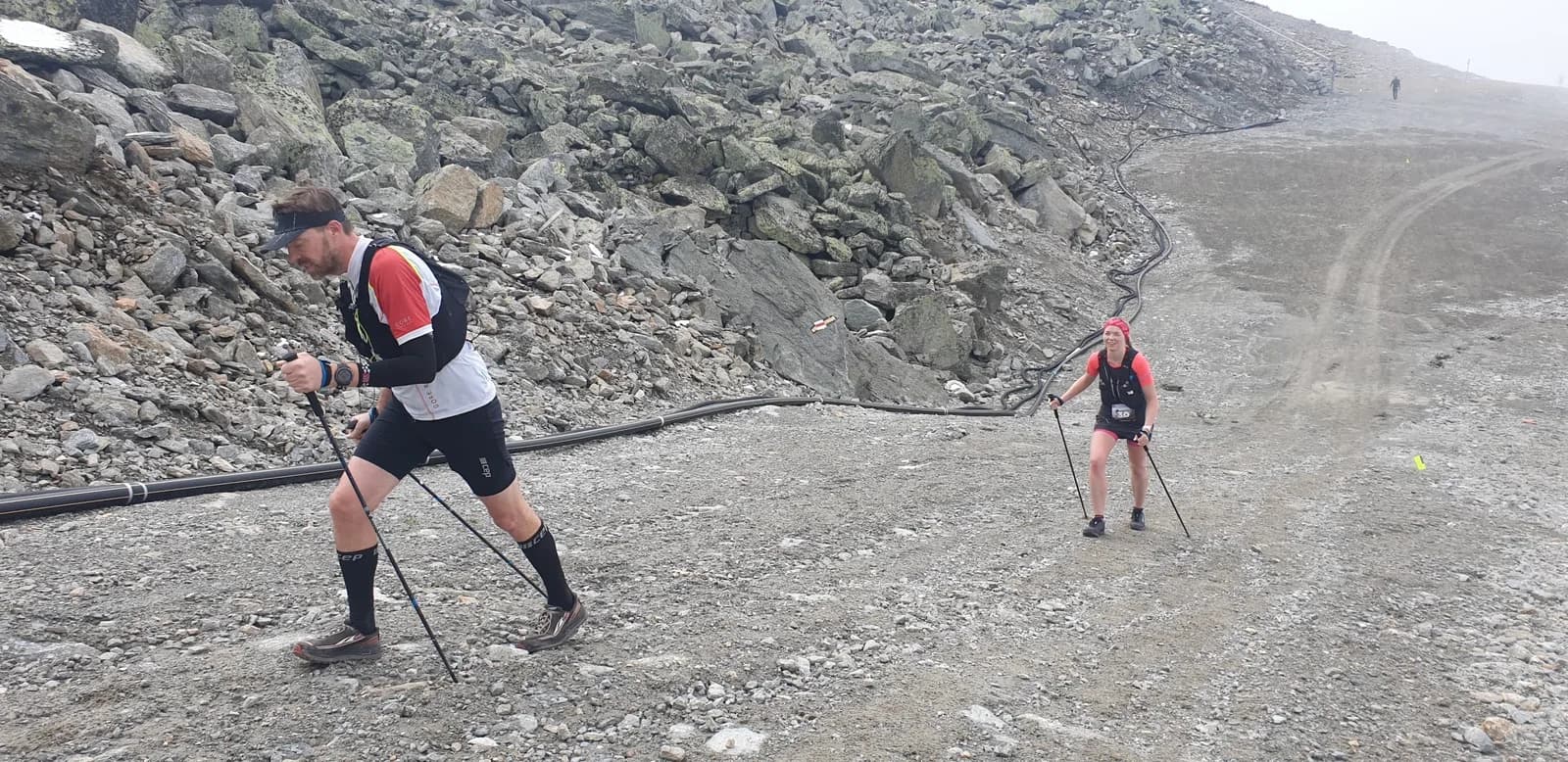
Best Trail Running Poles for Ultras and Steep Routes
Buy the Leki Ultratrail FX.One Superlite if you race and know your length, the Harrier Helvellyn Carbon if it is your first carbon pair, the Harrier Catbells if you are not sure poles are for you yet.
Affiliate disclosure: links to Amazon in this guide are affiliate links. If you buy through one we earn a small commission at no extra cost to you. Links to Harrier are not affiliate links; they're there because that's where you buy them. None of it makes any difference to which poles we tell you to buy.
The short version
Poles are the one bit of kit where the right answer depends more on you than on the product. Three pairs cover most runners. Find the line that sounds like you.
Buy this: Leki Ultratrail FX.One Superlite — if you race mountain ultras, already use poles and know your length. Carbon, fixed length, folds small, and Leki's Shark glove system means you clip in and out rather than fumbling with straps at every gate. The lightest, fastest pole here. It is also fixed length, so you have to get the size right, and the gloves take a few runs to stop feeling odd.
Spend less: Harrier Helvellyn Carbon Z-Poles V2 — if this is your first carbon pair, or you want one pair for running and hiking. Adjustable 110 to 125cm so the length question goes away, 4K carbon from 180g a pole, and the carbide tips, rubber tips, mud baskets and case are all in the box, which is not true further up the market. £109.99 direct from a UK company, against £150 and up for the Leki or Black Diamond equivalent. If you do know your length, the fixed-length Helvellyn PRO at £119.99 saves 40g a pole.
Not sure poles are for you yet: Harrier Catbells Aluminium Z-Poles V2 — if you're on your first ultra with big climbs and want to find out whether poles help before spending carbon money. £64.99, adjustable, same tips and case as the carbon version. Aluminium bends where carbon snaps, which matters while you're learning and when a tip jams between rocks on a descent. You'll notice the weight once they're folded and carried through a long runnable section, and that's the trade.
Still not sure? Want a carbon race pole with a normal strap instead of Leki's gloves: Black Diamond Distance Carbon Z. Want carbon and adjustable from a big brand: Black Diamond Distance Carbon FLZ. Fell runner who wants the simplest thing that works: Mountain King Trail Blaze. All three are further down.
We haven't run with all nine of these. They're here because they're what UK runners actually use and the figures hold up against the manufacturer's own, not against other people's lists. Weights in particular vary by length, so check the size you're buying.
The three picks
Leki Ultratrail FX.One Superlite
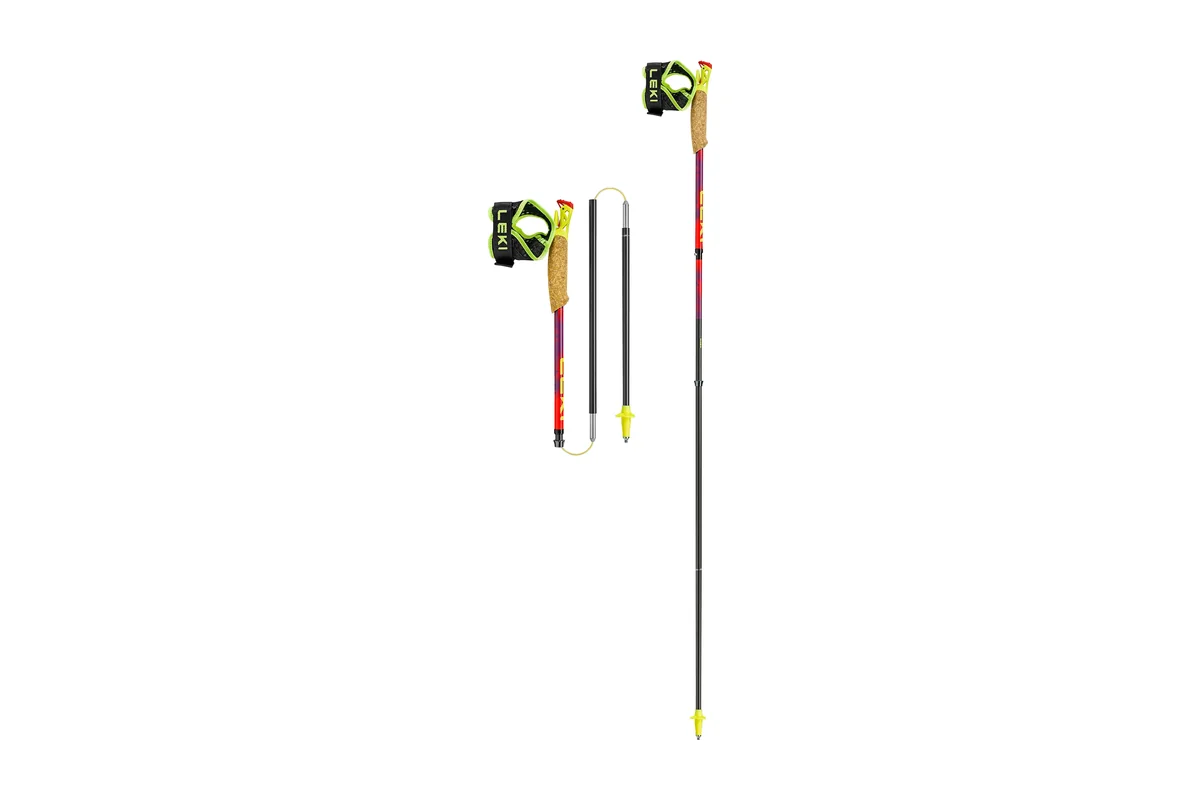
Carbon · fixed length · compact FX fold · Shark glove system
Built for trail racing and nothing else. The Shark system is the point: the glove clips onto the grip, so the pole hangs off your hand between plants and you let go at gates, checkpoints and drink stops without taking anything off. Once it's familiar it's faster than any strap. The Superlite is the lightest version of the FX.One, and the one you see at the front of Alpine races.
Watch out for: fixed length means choosing correctly before you buy, and the glove system takes a few runs to feel natural. Carbon this light is less forgiving of a trapped tip than a heavier pole. If you want the same grip system with a bit more shaft, the standard Ultratrail FX.One is below.
Harrier Helvellyn Carbon Z-Poles V2
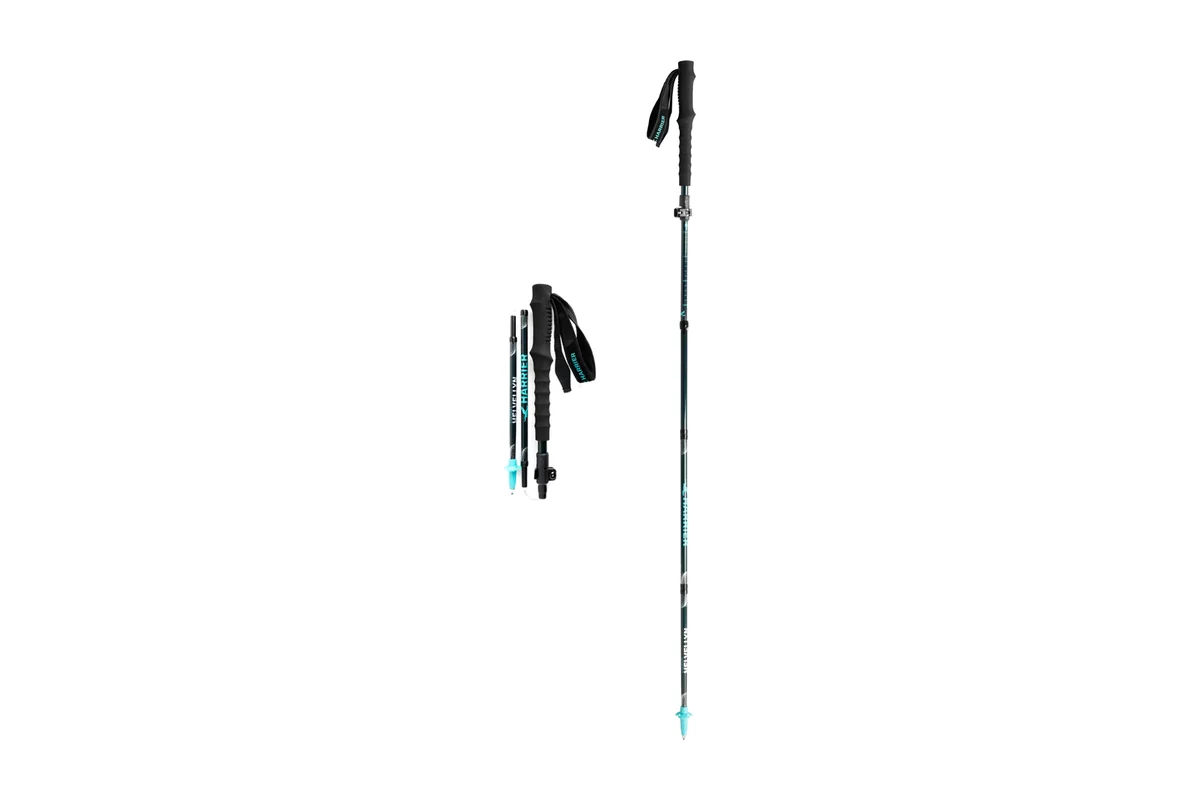
4K T300 carbon · from 180g a pole (380g the pair) · three-section Z-fold, 35cm packed · adjustable 110 to 125cm · £109.99
Harrier sell direct from the UK, and the price includes everything: carbide spike tips, rubber tips, fleece-lined straps, mud baskets and a carry case. That's £30 to £50 under a comparable Leki or Black Diamond, for a pole with a proper carbon shaft and a fold that packs as small. The adjustable range covers roughly 5ft3 to 6ft, so one size fits most people and you can shorten them for a steep descent. A credible first carbon pole, and for a lot of runners the last one they need.
The lighter race version is the Helvellyn PRO at £119.99: fixed length, six sizes from 105 to 130cm, 138g a pole.
Watch out for: an adjustable pole carries a little more weight and one more thing that can work loose than a fixed-length race pole. If you already know your length, buy the PRO instead.
Harrier Catbells Aluminium Z-Poles V2
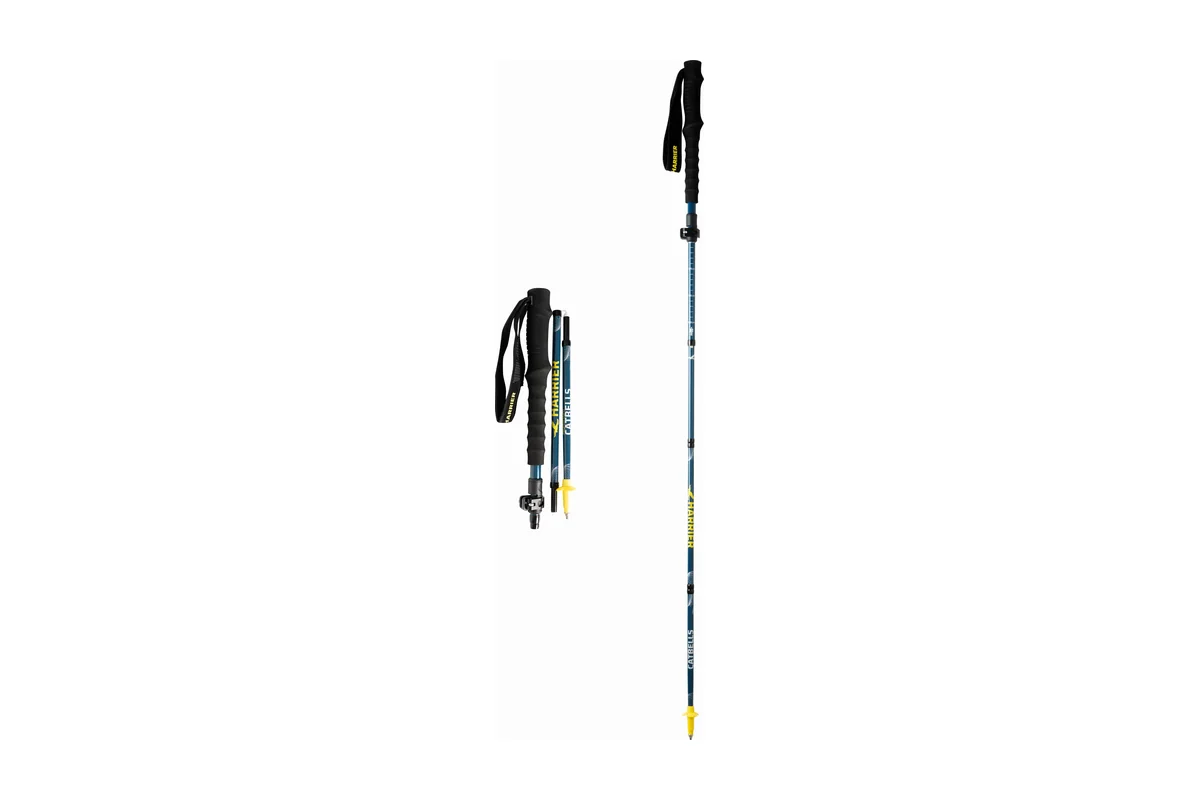
7075 aluminium · Harrier quote 235g to 270g a pole in different places on the same page · three-section Z-fold, 35cm packed · adjustable 110 to 125cm · £64.99
The cheapest sensible way into poles. Aluminium is heavier than carbon but it bends rather than snaps, which is what you want while you're still learning where to plant and when you catch a tip between two rocks on a descent. Same tips, straps, baskets and case as the carbon version. There's a fixed-length Catbells PRO at £79.99 in four sizes if you know your length and want the few grams back.
Watch out for: the weight, once they're folded and stowed through a long runnable section. And Harrier's own weight figures for this pole don't agree with each other, so treat them as a rough guide.
Also considered
Six more that are good poles with a narrower case for buying them.
Black Diamond Distance Carbon Z
The other race pole you see everywhere: carbon, fixed length, Z-fold, and a conventional strap and grip that need no learning. Light, quick to deploy, and the pick over the Leki if you'd rather not bother with gloves. Carbon this light dislikes side impacts and trapped tips. Amazon
Black Diamond Distance Carbon FLZ
The Carbon Z with an adjustment range, for sharing poles, changing technique or using one pair for running and hiking. The mechanism adds weight and one more thing to check mid-race. Amazon
Black Diamond Distance Z
The aluminium Distance: same fold, a little heavier, usually cheaper, more tolerant of knocks. A sound first pole if you want the Black Diamond feel. Still fixed length, so size it right. Amazon
Leki Ultratrail FX.One
The standard FX.One: the same Shark glove system as the Superlite in a slightly heavier, less delicate shaft. For a lot of runners the more sensible Leki for training and racing on rough ground. Same caveat on practising the glove clip. Amazon
Mountain King Trail Blaze
A long reputation among fell runners and lightweight hikers: simple folding aluminium, low weight, fast to deploy, nothing to adjust. The grip and strap are basic next to the ergonomic systems above, and that's rather the point. Amazon
TREKOLOGY Trek-Z
A cheap aluminium folding pole for finding out whether poles help on walking-heavy ultras before spending real money. Heavier, bigger folded and slower to swing than anything else here; if you decide you like poles, you'll replace them. Amazon
All nine at a glance
| Pole | Best for | Construction | Fold | Length |
|---|---|---|---|---|
| Leki Ultratrail FX.One Superlite | Racing, know your length | Carbon | Compact FX | Fixed |
| Harrier Helvellyn Carbon Z-Poles V2 | First carbon pair, UK value | 4K carbon, from 180g a pole | Z-fold, 35cm | Adjustable 110–125cm |
| Harrier Catbells Aluminium Z-Poles V2 | Finding out if poles suit you | 7075 aluminium | Z-fold, 35cm | Adjustable 110–125cm |
| Black Diamond Distance Carbon Z | Race pole with a normal strap | Carbon | Z-fold | Fixed |
| Black Diamond Distance Carbon FLZ | Carbon and adjustable | Carbon | Z-fold | Adjustable |
| Black Diamond Distance Z | Durable first race pole | Aluminium | Z-fold | Fixed |
| Leki Ultratrail FX.One | Leki gloves, tougher shaft | Carbon | Compact FX | Fixed |
| Mountain King Trail Blaze | Fell running, simplicity | Lightweight aluminium | Multi-section | Fixed |
| TREKOLOGY Trek-Z | Cheapest way to try poles | Aluminium | Z-fold | Adjustable versions |
What actually matters
Length. The usual starting point is an elbow at about 90 degrees with the tip planted beside your foot. Brand charts go by height, but steep ground wants shorter and your technique moves it too. If you're buying fixed length and haven't used poles before, borrow a pair first or buy adjustable.
Carbon or aluminium. Carbon is lighter and feels crisp. Aluminium is cheaper and bends before it breaks. For rocky training and a first pair, aluminium is the calmer choice; for racing, carbon.
Fixed or adjustable. Fixed is lighter and simpler and there's nothing to work loose. Adjustable lets you share, shorten for descents and use the same pair for hiking, at the cost of a mechanism and some grams.
Straps or gloves. A conventional strap works everywhere and needs no learning. Leki's Shark gloves are faster once you're used to them and a nuisance until you are. Decide before you buy, because it's the thing that decides between the two big brands.
Practise. Deploying, folding, stowing, eating, opening a gate and drinking from a flask, all without stopping. Bad pole handling costs more time than the poles save, and it's what puts most people off them.
Race rules. Some races allow poles throughout, some only from a certain checkpoint, some not at all. Read the current rules, not last year's.
Frequently asked questions
What are the best poles for trail running?
The Leki Ultratrail FX.One Superlite if you race and know your length. The Harrier Helvellyn Carbon if it's your first carbon pair or you want adjustable. The Black Diamond Distance Carbon Z if you want a race pole with a normal strap.
Are carbon poles worth it?
If you use poles regularly and weight matters, yes. If you're learning, or you run rocky ground where a tip gets trapped, aluminium is better value and more forgiving.
Can you run downhill with poles?
Yes, with practice. Keep the tips clear of your feet and other runners, and don't plant hard where a tip can jam between rocks.
Are poles allowed in trail races?
It varies. Some allow them throughout, some only from a set point, some ban them. Check the current rules for the race, not the general pattern.
How do you carry folded poles?
A vest quiver, a front bungee, a waist belt or dedicated pole loops. Whatever you choose, practise the exact setup on the move before race day.
Do trail running poles save energy?
They move some of the work to your arms and shoulders and keep you moving on steep climbs when the legs are gone. How much depends on the terrain and how well you use them.